

Read the article in Finnish here.
Dr Kienda Hoji is a London-based entertainment and media lawyer and academic specialising in copyright and contract law, with an exceptionally diverse career also as a manager, agent, and educator. He supervises doctoral researchers at two universities in London. He has also taught as a visiting lecturer at Peking University in China. Having previously worked in Finland, Hoji visited the country again this spring as part of the Klusteri project, appearing at several events. We met him in Helsinki to talk about the forces reshaping the music industry today.
Kienda Hoji was born into a home where music was woven into family life.
“Mornings often began with classical records chosen by my father, with jazz taking over later in the day.”
This environment shaped a career that moves fluidly between music, law, and education. Hoji went on to work as a manager across genres including rock, R&B, and soul, while maintaining a cross-sector perspective on the industry.
“Today, alongside my academic work, I manage artists in the UK and collaborate with organisations, record labels, and independent practitioners across the field.”
Alongside his industry work, Hoji has held senior academic roles, including Head of Department at the University of Westminster and Deputy Vice-Chancellor at the Academy of Contemporary Music. He currently teaches music business and media law at universities in London.
Hoji’s research critically examines intellectual property, focusing on its limitations beyond Western frameworks.
“My recent work explores the impact of AI on music, race bias in industry practices, and how legal systems translate across different cultural contexts.”
Music, Work, and a Lasting Connection to Finland
Hoji’s connection to Finland began through teaching at the Sibelius Academy in Helsinki during the late 1990’s, where he was involved in continuing education programmes, including courses for rock managers. Through this work, he gained close insight into the Finnish music industry and its ways of operating.
“What struck me at the time, and may still hold true, was that the Finnish industry was strongly oriented around live performance, particularly festivals.”
In this context, the role of the manager often resembled that of an agent – a distinction that Hoji emphasises as important.
“That distinction matters. Agents focus on live performance; managers are responsible for the overall career.”
Part of his work in Finland involved encouraging a shift toward a broader understanding of management, not only organising performances, but shaping long-term artistic careers. During this time, Kienda also worked directly with Finnish artists, including managing the duo Kwan and collaborating with the artist Redrama.
“What drew me to both Kwan and Redrama was their sense of identity and social perspective. I’ve always been interested in artists who engage with social meaning, not just entertainment.”
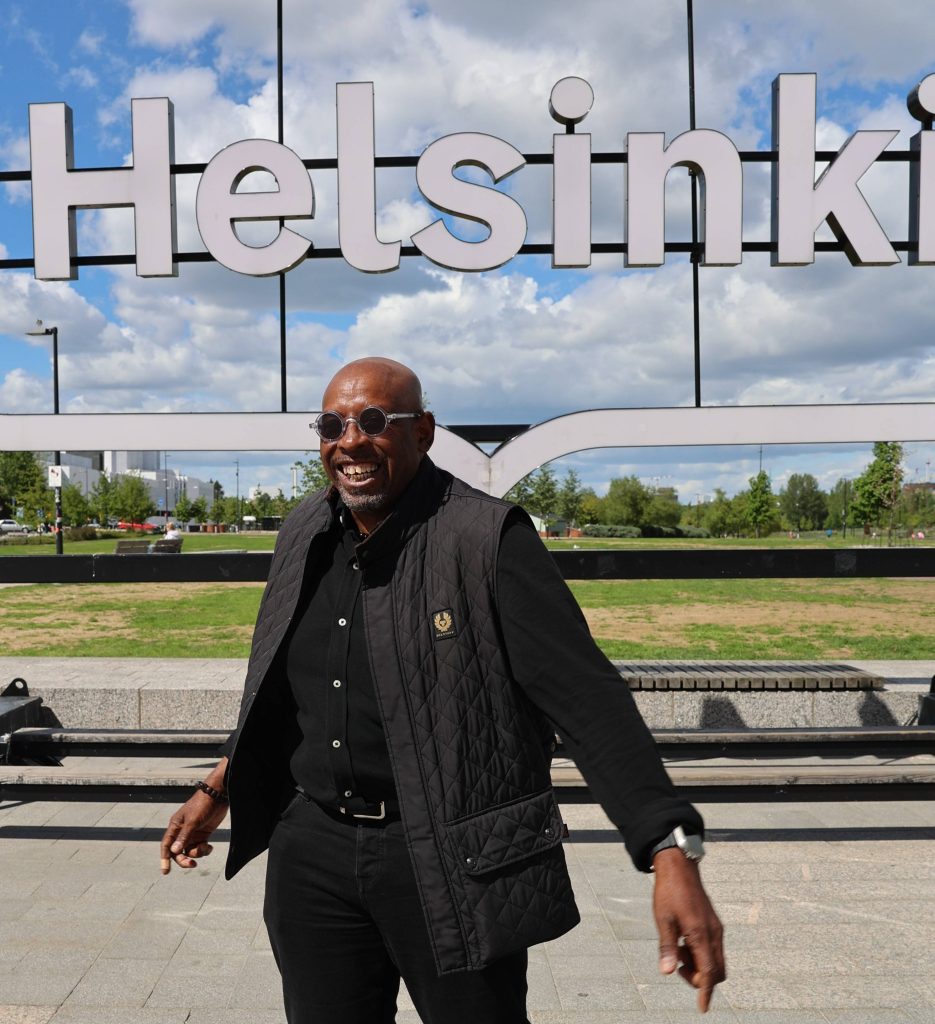
Kienda Hoji in Helsinki
The Expanding Role of today’s Manager
Over the past decades, the music industry has undergone profound changes and with it, the role of the manager. In earlier phases of the industry, the manager’s role was clearly defined: guiding an artist’s career, negotiating deals, selecting partners such as record labels, and organizing live performances. Managers acted as advocates and long-term strategists. According to Hoji, those responsibilities still exist, but the environment around them has been transformed.
“Technology has reshaped both the management process and the creative environment. Artists are no longer just musicians – they are content creators operating across multiple platforms.”
Today, revenue streams extend far beyond music itself into streaming, social media, film, television, gaming, and advertising.
“As a result, artists have to think beyond sound. They need to engage with visuals, identity, fashion, and storytelling.”
This, in turn, has expanded the manager’s role into something much broader.
“The new era requires new skills: negotiating across industries, understanding different forms of media production, identifying diverse revenue streams, and positioning the artist within a complex, interconnected marketplace. Managers today need to be highly business-minded and strategically versatile.”
Navigating a Changing Music Industry
Hoji notes that technological change has not only reshaped roles – it has transformed the entire structure of the music industry. On the production side, music is no longer tied to studios or large teams. Increasingly, it is created in home environments with minimal equipment.
“This has democratized production, but it has also changed how we understand artistry and how we value creative work.”
On the distribution side, the transformation has been even more far-reaching. The industry has shifted from ownership to access: from buying records to streaming music through digital platforms. This change has affected not only how people listen to music, but also the economic foundations of the entire field. For many artists, particularly those at the beginning of their careers, these changes have made the landscape more complex.
“An artist who focuses solely on making music is unlikely to succeed financially in today’s environment.”
Instead, success depends on adaptability and the ability to operate across multiple contexts. As Hoji points out, this means engaging with technology, building presence across platforms, and creating content beyond music itself. This includes understanding areas such as synchronization – how music is used in film, television, and gaming – as well as thinking beyond one’s own performances.
“Artists need to consider writing for others, working in different formats, and expanding their creative output.”
Ultimately, this broader thinking extends beyond artists themselves.
“Success today requires flexibility and strategic understanding from everyone in the ecosystem – artists, managers, agents, labels, and publishers.”
AI and the Transformation of Creativity
At this moment, one of the most significant forces shaping the industry is artificial intelligence.
“We are in a period of transition. There is no clear formula yet for how to deal with it – we are building the system as we go.”
AI has made music creation accessible to a wider range of people than ever before.
“Anyone can create a song, even one that achieves major commercial success, without a deep musical background.”
Hoji notes, that while this development is often described as democratizing, it also introduces uncertainty.
“The output may not carry the same depth, intention, or storytelling as traditional artistic processes,” he describes.
The speed of creation has also changed dramatically.
“A piece of music can now be created and released within a single day and still generate significant revenue.”
At the same time, AI is evolving from a tool into something more autonomous.
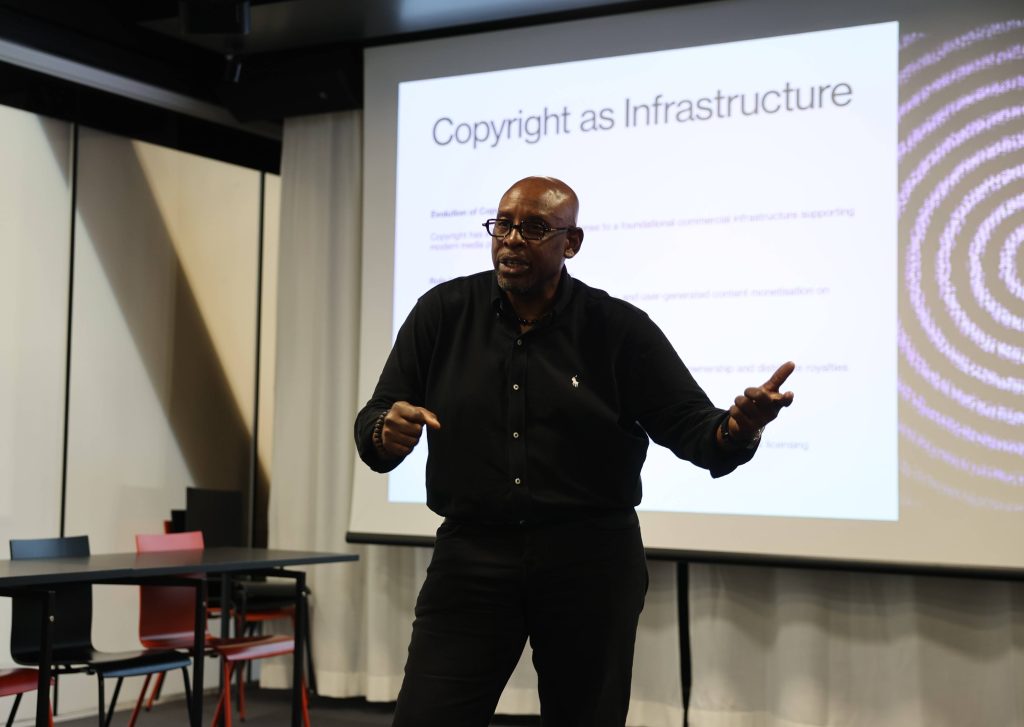
Kienda Hoji giving a lecture in Helsinki. Picture: Nina Castén
“It is increasingly capable of generating content independently.”
For Hoji, these developments point toward something deeper: a shift in how we understand the role of the human creator.
“Technology will continue to evolve rapidly – that is inevitable. We may be moving toward a future where machines surpass human capabilities in creative processes.”
For Hoji, this opens up fundamental questions.
“What is creativity? What is consciousness? At what point does a machine become something more than a tool?”
Although these questions may sound abstract, Hoji emphasises that they are grounded in current developments rather than distant speculation. At the same time, he returns to a note of cautious optimism.
“There is still space for human creativity, and it is essential that we continue to develop and value it. The goal is to help people understand their own creative capacity.”
Music, in this sense, offers a powerful lens.
“It is one of the most fundamental forms of human creativity. It reflects how people think, feel, and communicate.”
Manager Compensation and Industry Practices
The way managers earn their income has, in principle, remained relatively straightforward.
“Managers earn commission on the income they generate for their artists. They only earn if the artist earns.”
This model is often summed up in the phrase you eat what you kill. While alternative models, such as fixed monthly fees, have emerged, they may carry risks.
“Fixed monthly fees can be problematic, particularly if artists are paying without seeing results.”
At the same time, new roles such as social media managers have begun to resemble service-based professions, operating differently from traditional management. At the heart of the manager-artist relationship lies a legal and ethical principle: fiduciary duty.
“This means that the manager must act in the best interests of the artist at all times.”
As Hoji explains, this principle places strong emphasis on independence.
“A manager must avoid situations where their interests conflict with those of the artist. If a manager also controls a record label, they may end up negotiating with themselves rather than acting independently on behalf of the artist.”
Understanding these structures is essential to navigating the industry in a sustainable way.
When Does an Artist Need a Manager?
“When an artist decides to take their career seriously – that is the moment.” Hoji states.
For those engaging in music as a hobby, management is not necessary. But once music becomes a professional path – with long-term goals, strategy, and ambition – management becomes increasingly relevant.
Hoji believes that it is entirely possible to find managers in Finland. What matters first is the existence of a management culture and that culture has been developing. At the same time, he emphasises the importance of initiative.
“Opportunities should not be waited for passively – they need to be actively sought.”
He also encourages artists to consider working with emerging managers.
“Many of the strongest partnerships develop over time, through shared growth.”
Networks, associations, and professional communities play a key role in building these connections. Within the broader industry, the role of the manager has also become more central as a gatekeeper.
“Record labels and publishers increasingly prefer to work with managers rather than directly with artists.”
Representation signals professionalism and helps reduce perceived risk.
“There have been cases where an artist received no response – until they approached the same company through a manager.”
Artist Wellbeing as a Rising Issue
In recent years, artist wellbeing has increasingly come to the forefront, partly due to the growing pressures experienced by artists, Hoji explains. As a result, managers are now expected to take responsibility not only for career development, but also for ensuring health, safety, and ethical treatment within the industry. Hoji has encountered situations where contracts needed to include specific clauses safeguarding artist wellbeing, something that would have been unusual in the past.
“Artists should not be placed under constant pressure to perform or expected to be continuously available on social media,” he describes.
Today, there is a growing effort to incorporate safeguards – such as recognising early signs of stress and burnout – directly into contractual frameworks.
“Looking after an artist’s wellbeing means, for example, including provisions for rest periods, time off, and conditions that ensure a humane workload.”
More broadly, this reflects a shift in mindset: being an artist is increasingly recognised as a profession, rather than something that exists outside normal working conditions. In the UK, organisations such as the Creative Industries Independent Standards Authority are addressing issues such as discrimination and abuse, reflecting a broader shift from ignoring these challenges towards actively confronting them. According to Kienda Hoji, these significant challenges are addressed particularly through education, raising awareness, and strong representation.
Why Music Matters
At the end of the conversation, the discussion turns to something more fundamental: the meaning of music itself and how music managers end up on their careers.
“It is about an understanding on human need in relation to art – and that is what often leads people into profession of music management.”
Hoji reflects on this also in a personal way. His grandchildren are studying music.
“That is a wonderful thing. Music develops a person in many ways – it builds cultural understanding, discipline, sensitivity, and the ability to perceive the world more deeply.”
“It can provide a strong foundation for many paths in life – even an international career.”
Interview and text: Nina Castén
Published: 1.10.2026


